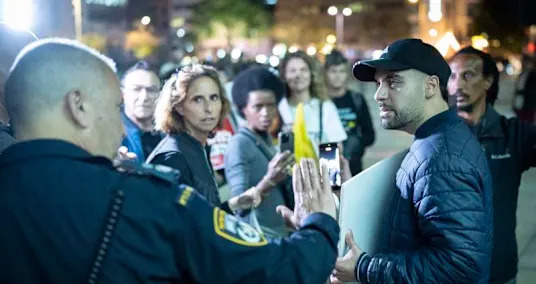
Protests took place in Tel Aviv, Jerusalem, Haifa, and Beersheba, as a survey found broad but uneven support among Jewish Israelis for Operation Roaring Lion.
Israel Police arrested 21 anti-war protesters Saturday night as demonstrations against the conflict with Iran expanded in multiple cities despite restrictions on public gatherings.
Protests took place in Tel Aviv, Jerusalem, Haifa, and Beersheba, with hundreds of participants reported in Tel Aviv and Jerusalem and about 100 in Haifa, marking the largest turnout since weekly demonstrations began. Authorities said 13 people were arrested in Tel Aviv and eight in Haifa.
Police said the gatherings were not approved under Home Front Command regulations that ban events with more than 50 people. Officials said the increase in turnout followed calls by groups opposing the government to protest despite the restrictions.
“During a situation assessment that took place at the scene with a Home Front Command representative… it was clarified that there was a real risk to human life and accordingly, Yarkon [precinct] police commander Tzachi Sharabi ordered the gathering to be dispersed,” police said.
Hadash-Ta’al chairman Ayman Odeh, an Arab lawmaker involved in the protests, criticized the police response, calling officers fascists “in the service of the government” and saying they were afraid of “the heroic citizens who went out, despite everything, to make their voice heard.”

Survey shows broad, uneven support for war
The demonstrations come as a March 2026 survey by the Israel Democracy Institute found broad but uneven support among Jewish Israelis for Operation Roaring Lion. Support was strongest on the Right at 87% and about half on the Left.
The survey also found that Jewish and Arab respondents largely agreed that Iran’s resilience has been stronger than expected. Most Jewish respondents said Israeli society could sustain the campaign for up to one month, while 28% said as long as needed. Arab respondents were less optimistic about how long the public could endure the conflict.
A majority of Jewish respondents said Prime Minister Benjamin Netanyahu’s decision was driven by security considerations, while most Arab respondents viewed it as political.
LATEST POSTS
- 1
 Kids may be more likely to get the new ‘Cicada’ variant of Covid-19, scientists say. Here’s what to know about BA.3.2
 - 2Find the Historical backdrop of Common liberties: Advancing Equity and Equity Around the world
- 3Between 600 to 800 aid trucks entering Gaza daily since start of ceasefire, COGAT confirms
- 4Bring tissues and skip the mascara: The movie that's making theater-goers sob uncontrollaby
- 5Zendaya serves bridal-coded fashion with old, new and borrowed gowns for ‘The Drama’ press tour




- Africa's energy giants eye long-term gains on Iran war disruption
- December's overlooked meteor shower peaks next week — will the Ursids surprise us?
- NASA loses contact with its Maven spacecraft orbiting Mars for the past decade
- Vote in favor of your #1 Kind of Cap
- 6 Tire Brands Reasonable for Seniors
- First Greenland, now Iceland? Annexation joke by Trump ally gets frosty response in the Arctic nation.
- Nestlé recalls infant formula in 49 countries. See list.
- This cafe takes orders in sign language. It's cherished by the Deaf community
- Should you get an RSV vaccine this fall? What to know and where to get a shot