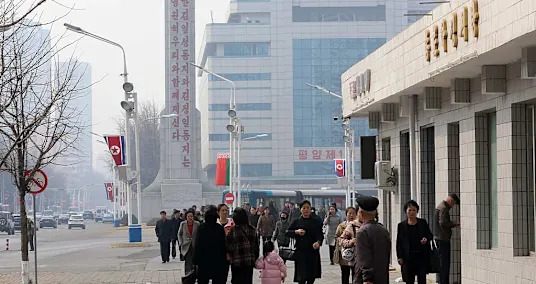
China has announced that its flag carrier, Air China, will resume direct flights to North Korea after a six-year pause, following the restoration of passenger train services between Beijing and Pyongyang.
This marks a significant step toward reopening North Korea, one of the world's most isolated nations, to the world.
Transport links between the two capitals had been suspended since the start of the Covid-19 pandemic in 2020, when Pyongyang implemented a very strict border closure.
While North Korean carrier Air Koryo already resumed flights to Beijing in 2023 and allowed Russian tour groups to visit in 2024, the return of China's air and railways are seen as a major economic milestone, as China has for decades been the main trading partner and a key source of diplomatic and economic backing for the country of 26 million people.
Before the pandemic, there were an estimated 300,000 foreign visitors in 2019, according to South Korea's Institute for International Economic Policy, and Chinese visitors accounted for 90% of all tourists to North Korea. Therefore, the long delay in resuming regular travel had surprised many regional observers.
"The reopening of these borders has been driven primarily by Pyongyang's timeline, which challenges the outdated assumption that Beijing dictates terms to a dependent client state," Seong-Hyon Lee, a visiting scholar at the Harvard University Asia Centre, explains.
Related
Nuclear ambitions complicated the relationship
Despite being Pyongyang’s primary ally, Beijing has frequently voiced disapproval over the North's persistent missile tests and nuclear ambitions. This aspect created a bumpy relationship with Pyongyang, with analysts saying that a nuclear-armed North Korea has often been something of a liability.
The diplomatic normalisation was highlighted last September, when Kim Jong Un attended a massive military parade in Beijing alongside Russian President Vladimir Putin. This was Kim's first appearance at a Chinese military display.
Lim Eul-chul, a North Korea expert at South Korea's Kyungnam University, argues that the war in Iran, in particular, increased "the need for closer coordination between the two nations".
LATEST POSTS
- 1
 Katz, IDF: We assassinated IRGC intelligence chief Majid Khademi
 - 2Step by step instructions to Figure out the Natural Effect of 5G Pinnacles
- 3Find the Effect of Web-based Entertainment on Society: Exploring the Computerized Scene
- 4Don't fall for it: These common tourist scams in Rome are easy to avoid if you know what you're looking for
- 54 Must-Visit bar-b-que Eateries This Year




- Tasting America: An Excursion Through Darling Cheap Food Brands
- A Lone Wolf Outsmarted Hunters in the Black Forest and Then Vanished
- This Luxurious Thermal Spa In Italy Is Perfect For A Relaxing Escape While Visiting Milan
- How to watch 2026 Golden Globe winners like 'One Battle After Another,' 'Adolescence' and 'The Pitt'
- 'The Real Housewives of Rhode Island' 1st teaser trailer unveiled: Which Bachelor Nation star is part of the cast? And when does it premiere?
- Figure out How to Recognize Early Indications of Depressions
- The Ascent of Robots: Occupations That Man-made brainpower Might Dispense with
- Israeli tourist data from 2025 misrepresented as mass exodus to Thailand
- NI economy losing momentum due to Iran crisis